
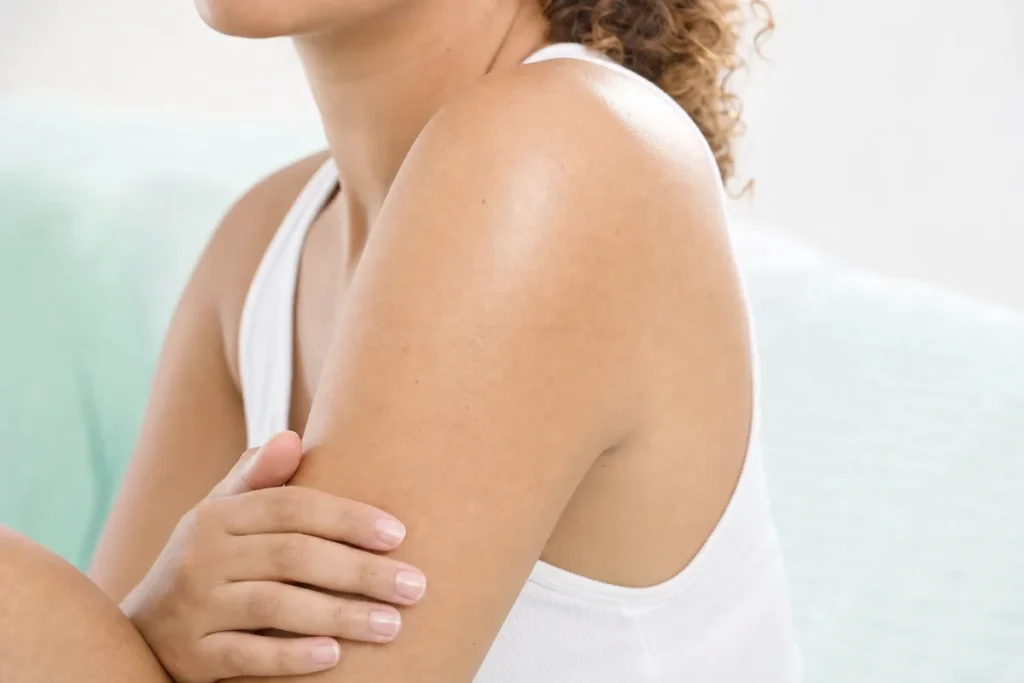
Keratosis pilaris is the small rough bumps, often called chicken skin, that appear on the backs of the upper arms, the fronts of the thighs, the buttocks and sometimes the cheeks. It is caused by keratin plugging the hair follicles, it is completely harmless, and it affects a very large number of people at some point, most often from childhood into the twenties. It cannot be cured. It can be improved a great deal, and most of that improvement comes from what you do at home rather than from anything done in a clinic.
This guide sets out what actually works, in the order we would try it, and where a clinic treatment at Halcyon Medispa in Marylebone genuinely adds something that a cream cannot. It also says plainly what does not work, because a lot of what is sold for keratosis pilaris makes it worse.
The short answer: use a urea or lactic acid cream on the area every day and stop scrubbing it. Give that twelve weeks before you judge it. If the bumps have softened but the redness has not, that is the point at which a laser or a peel is worth booking, because redness is the part topical treatment is worst at.
In this guide:
- What keratosis pilaris actually is
- Where it appears and who gets it
- Why it is worse between October and March
- The home routine that does most of the work
- What a clinic can add, and what it costs
- How long each stage takes
- Who each treatment suits, and who it does not
- What does not work, and what makes it worse
- When it is not keratosis pilaris
- Frequently asked questions
What keratosis pilaris actually is
Every hair on your body grows out of a follicle, and each follicle is lined with keratin, the same structural protein that makes up hair and nails. In keratosis pilaris the body produces more keratin than the follicle can clear. The excess forms a hard plug at the opening, the trapped hair curls underneath it, and the result is a small raised bump with a slightly rough top. Run a hand over the back of an upper arm with keratosis pilaris and it feels like fine sandpaper or the skin of a plucked chicken, which is where the common name comes from.
There are two things worth separating, because they respond to different treatments:
- The bumps themselves, which are the keratin plugs. These respond well to the right exfoliating ingredients used consistently.
- The redness or brown discolouration around them, sometimes called keratosis pilaris rubra when it is red. This is inflammation and pigment in the surrounding skin, and creams barely touch it. This is the half a clinic can help with.
It is not an infection, it is not contagious, it is not caused by poor hygiene, and it is not dangerous. Dermatologists class it as a benign variant of normal skin rather than a disease, which is also why nobody has ever produced a cure.
Where it appears and who gets it
| Where | How common | What it usually looks like |
|---|---|---|
| Backs of the upper arms | The classic site, by a long way | Fine rough bumps, often with pink or brown surrounding skin |
| Fronts and outsides of the thighs | Very common | Larger area, often less red than the arms |
| Buttocks | Common, rarely mentioned | Bumps that are easily mistaken for spots |
| Cheeks and jawline | Less common, mostly in children | Persistent pink roughness that gets treated as acne and does not respond |
It runs in families, and it sits alongside dry skin and eczema more often than chance would explain. If you already have dry skin or a history of eczema, keratosis pilaris is more likely and more stubborn. It typically appears in childhood, is at its most obvious in the teens and twenties, and quietly improves for many people through their thirties and forties. That last point matters when you are deciding how much to spend on it.
Why it is worse between October and March

Almost everyone with keratosis pilaris finds it is at its worst in winter, and in a London flat with the heating on there is a good reason for it. Cold outdoor air holds very little moisture, indoor heating strips out what is left, and the skin barrier loses water faster than it replaces it. Dry skin cannot shed its surface cells cleanly, so the plugs build up faster than they clear.
The practical consequence is one of the few genuinely useful pieces of timing advice in this whole subject. Start in February, not in June. Keratosis pilaris takes about three months of consistent treatment to show its full improvement, so people who begin when the weather turns warm and they notice their arms are still working against the clock. Begin at the end of winter and the skin is where you want it by the time sleeves come off.
The home routine that does most of the work
We are going to be blunt about the order here, because it is the opposite of how keratosis pilaris is usually sold. A daily cream with the right active ingredient will do more for the bumps than any single clinic treatment, and it costs a fraction as much. Anyone who tells you otherwise is selling you a course.
The ingredients that actually do something
| Ingredient | What it does | How to use it |
|---|---|---|
| Urea, 10 to 20 per cent | Softens and dissolves the keratin plug and holds water in the skin at the same time. The single most useful ingredient for this condition. | Once daily on the area, after a shower, on skin that is still slightly damp. |
| Lactic acid, 5 to 12 per cent | Loosens the bond between surface skin cells so the plugs shed. Gentler than glycolic on body skin. | Once daily, or alternate days if the skin stings. |
| Salicylic acid, 2 per cent | Oil soluble, so it works inside the follicle itself. Useful where the bumps are inflamed. | Two or three times a week rather than daily. |
| Glycolic acid | Effective but more irritating on already pink skin. Worth trying only if lactic acid has not been enough. | Two or three times a week. |
| A plain, thick moisturiser | Does nothing to the plugs directly, but a barrier that is not dry is a barrier that sheds properly. | Every day, and twice a day in winter. |
The rule that matters more than the product: use it every day for twelve weeks before you decide it has not worked. Almost every person who tells us a keratosis pilaris cream did nothing used it for a fortnight.
And the two habits to change
- Stop scrubbing. Loofahs, exfoliating mitts and gritty scrubs feel like the obvious answer to rough skin and they are the fastest way to make the redness worse. Chemical exfoliation dissolves the plug. Mechanical scrubbing inflames the skin around it.
- Stop picking. Squeezing a plug out leaves a mark that outlasts the bump by months, and on darker skin tones that mark can be permanent.
Shorter, cooler showers help too, and so does patting rather than rubbing dry, although these are small effects next to the daily cream.
What a clinic can add, and what it costs
A clinic is worth involving in two situations: the redness has not moved after three months of proper home care, or the texture has improved but not enough and you want to accelerate it. What we would use depends on which of those you are dealing with.
| Treatment | What it targets | Published price |
|---|---|---|
| Aerolase laser | The redness. It also treats post inflammatory pigment and ingrown hair, which is why it suits keratosis pilaris rubra better than anything else on this list. | £250 per facial session |
| Carbon laser facial | Surface texture, blocked pores and rough skin. Gentler and cheaper than Aerolase, less effective on redness. | £150 per facial session |
| Chemical peel | The keratin plugs, using a stronger acid concentration than anything sold for home use. | Face £130, BioRePeel £180, Obagi Blue Radiance £180 |
| Dermapen microneedling | Texture and the surrounding skin quality rather than the plugs themselves. Worth considering where old marks from picking are the real complaint. | Full face from £170 with our aesthetician |
| RF microneedling, body | Texture on larger body areas such as the backs of the arms. | £400 per body area |
A note on the prices above. The laser and peel figures on our price list are for facial treatments. Keratosis pilaris most often sits on the arms and thighs, which is a different and larger area, so the body figure is the relevant one and anything else is quoted at your consultation. A consultation is £200 with Dr. Osman Bashir Tahir or £100 with our aesthetic physician, redeemable against your treatment, and a laser patch test is free.
Whatever is used, keratosis pilaris is treated as a course rather than a single appointment, and the home routine continues throughout. A clinic treatment on top of no daily cream is money spent on something that will come back.
How long each stage takes
| Point | What you should be seeing |
|---|---|
| Week 2 | Nothing much. The skin may feel slightly smoother after a shower. This is the point most people give up, and it is too early. |
| Week 4 to 6 | The bumps are noticeably flatter to the touch. The redness is usually unchanged. |
| Week 12 | The texture change is obvious, including to other people. Any remaining complaint is almost always colour rather than roughness. |
| After a course of laser | The redness settles over several weeks following the last session. This is the part that changes how the skin looks in a photograph. |
| Stopping treatment | The plugs return over roughly two to three months. Keratosis pilaris is managed, not cured, and maintenance is the daily cream rather than more appointments. |
Who each treatment suits, and who it does not
- A daily urea or lactic acid cream suits everyone with this condition, at every age, on every skin tone. There is no case where it is not the first thing to do.
- Aerolase suits the person whose main complaint is colour, particularly on richer skin tones where the pigment left behind is the visible problem. It does not suit someone who has not yet tried three months of home care, because the texture work has to happen first.
- A peel suits stubborn texture on a smaller area, and it does not suit skin that is currently inflamed or sunburnt.
- Microneedling suits the marks left by years of picking rather than the bumps themselves, and it is the wrong choice for someone with active, angry keratosis pilaris.
- We would not treat a child's keratosis pilaris in a clinic at all. It is harmless, most of it fades on its own, and a moisturising routine plus leaving it alone is the correct answer at that age.
Keratosis pilaris is managed rather than cured, and the daily cream is the maintenance. A course of anything, without that, buys you a few good months.
What does not work, and what makes it worse
- Scrubs, loofahs and exfoliating gloves. They inflame the skin around the plug without removing it. The bumps stay and the redness gets worse.
- Picking or squeezing. Reliably swaps a bump you can feel for a mark you can see.
- Coconut oil on its own. A pure occlusive with no exfoliating action. It will soften dry skin and do nothing at all to a keratin plug.
- Sunbeds or a tan to disguise it. The contrast fades briefly, the skin damage does not, and the pigment left behind afterwards is worse than what you started with.
- Anything advertised as a cure. There is not one. Treat any product making that claim as a reason to distrust everything else on the label.
- Antibiotics or acne treatments. Keratosis pilaris on the cheeks is regularly mistaken for acne and treated for months with things that cannot work on it, because it is not caused by bacteria.
When it is not keratosis pilaris
Keratosis pilaris does not itch much, does not weep, does not spread quickly and does not hurt. If what you have does any of those things, it is worth having it looked at properly rather than treating it as chicken skin. The conditions most often confused with it are eczema, folliculitis where the follicles are actually infected, ingrown hairs after shaving or waxing, and ordinary body acne.
A sudden appearance in adulthood, on an area that has never had it, is also worth a conversation. Keratosis pilaris is usually a lifelong pattern rather than something that arrives one winter.
Frequently asked questions
What is keratosis pilaris?
Small rough bumps caused by keratin plugging the hair follicles, usually on the backs of the upper arms, the thighs, the buttocks and sometimes the cheeks. It is harmless, not contagious, and very common from childhood into the twenties.
Can keratosis pilaris be cured?
No. It can be improved substantially and kept under control, but there is no cure and it returns if treatment stops. Any product claiming to cure it is overstating what is possible.
What is the best treatment for keratosis pilaris?
A daily cream containing 10 to 20 per cent urea or 5 to 12 per cent lactic acid, used consistently for at least twelve weeks. That does more for the bumps than any single clinic treatment. Laser and peels are worth adding when the redness or the texture has not moved after that.
Why is my keratosis pilaris worse in winter?
Cold air holds little moisture and indoor heating removes more, so the skin barrier dries out and cannot shed surface cells cleanly. The plugs then build up faster than they clear. Starting treatment in February rather than June puts you ahead of it.
Does exfoliating help keratosis pilaris?
Chemical exfoliation with urea, lactic acid or salicylic acid helps. Physical scrubbing with a loofah, mitt or gritty scrub does not, and it makes the redness worse. This is the most common mistake we see.
How long does it take to see a difference?
About four to six weeks for the bumps to feel flatter and around twelve weeks for the change to be visible to other people. The redness takes longer and often needs a clinic treatment.
Can laser treat keratosis pilaris?
Laser will not remove the keratin plugs, but it is the best option for the redness and the pigment left behind, which creams barely touch. Aerolase is the device we would use for that, and it also treats post inflammatory pigment and ingrown hair.
How much does keratosis pilaris treatment cost in London?
At Halcyon Medispa a consultation is £200 with Dr. Osman Bashir Tahir or £100 with our aesthetic physician, redeemable against your treatment, and a laser patch test is free. Published facial prices include Aerolase at £250 and a carbon laser facial at £150, and body areas such as the arms are quoted at consultation because the area is larger.
Is keratosis pilaris the same as acne?
No. Acne is driven by oil and bacteria, keratosis pilaris is a build up of keratin. They can look similar on the cheeks, which is why keratosis pilaris is sometimes treated as acne for months without improving.
Will keratosis pilaris go away on its own?
Often it fades gradually through the thirties and forties, and many people find childhood keratosis pilaris improves considerably by adulthood. It rarely disappears overnight and it does not usually go away in the teens and twenties, which is when it bothers people most.
Should I treat my child's keratosis pilaris?
We would not treat it in a clinic. A gentle moisturiser, short warm rather than hot baths and leaving it alone is the right approach in childhood, and most of it improves with age.
Does keratosis pilaris leave scars?
The condition itself does not. Picking and squeezing does, and on darker skin tones those marks can be long lasting or permanent. That is the single strongest reason to leave it alone.
Halcyon Medispa is an aesthetic clinic in Marylebone, London, led by Dr. Osman Bashir Tahir. If keratosis pilaris has not responded to a proper home routine, a consultation will tell you whether the remaining problem is texture or colour, and which of the two is worth treating. See the keratosis pilaris page for the treatments we offer, or the full price list.