

PRP for hair loss works for the right problem, and the best current evidence is more specific than most clinic pages admit: it increases how many hairs are growing per square centimetre, and it does not reliably make each individual hair thicker. That distinction decides whether you will be pleased with the result. If your parting is widening and you can see scalp through it, PRP has something to offer. If your hair is receding at the temples and has been for fifteen years, it does not.
This is written from how we run the treatment at Halcyon Medispa in Marylebone, with the published research alongside it, including the parts of that research that are inconvenient.
The short answer: yes for early to moderate pattern hair loss, where the follicles are still alive but miniaturising. PRP uses your own blood, takes a course of sessions four to six weeks apart, and needs maintenance every four to six months to hold. It will not regrow hair on a bald scalp, because there is nothing left there to stimulate. Hair PRP at Halcyon is from £300 with our aesthetic physician and £450 with Dr Osman Bashir Tahir.
In this guide:
- What PRP is, in one paragraph
- What the evidence actually says
- Density is not thickness, and why that matters to you
- Who it works for, and who it will disappoint
- What a session at our Marylebone clinic involves
- The timeline, month by month
- Why it is not permanent, and what that costs
- PRP against MCT exosomes
- Aftercare, and the shedding nobody warns you about
- What it costs at Halcyon
- Frequently asked questions
What PRP is, in one paragraph
Platelet rich plasma is made from your own blood. A small sample is taken from your arm exactly as it would be for a blood test, spun in a centrifuge to separate it into layers, and the platelet rich layer is drawn off into a syringe. Platelets carry growth factors, which are the signalling proteins the body uses to tell tissue to repair itself. Injected into the scalp in the areas where hair is thinning, they raise the local concentration of those signals around follicles that have started to shrink. Nothing synthetic goes in, which is why the allergy risk is essentially nil and why it can be repeated indefinitely.
What the evidence actually says
PRP has been studied properly, which is more than can be said for a lot of what is sold for hair loss.
The largest synthesis to date was published in Dermatology and Therapy in 2025. It pooled 43 randomised controlled trials, 41 of them in the quantitative analysis, covering 1,877 people, roughly 73 per cent of them men, aged from 10 to 79. Two findings are worth carrying away from it. Activated PRP increased hair density compared with placebo and reduced the rate of recurrence. And PRP did not significantly affect hair thickness.
The authors are also clear about the weakness in the field: the trials differ widely in how the PRP was prepared and how often it was given, reporting on those variables is incomplete, and they call for standardised trials before anyone treats the numbers as settled. In plain terms, the treatment works, and nobody can yet tell you which precise protocol works best. Any clinic quoting you a single definitive percentage is quoting one study rather than the field.
Density is not thickness, and why that matters to you
This is the single most useful thing on this page, so it gets its own section.
Density is how many hairs are growing in a given patch of scalp. Thickness is the diameter of each individual shaft. Pattern hair loss reduces both: follicles miniaturise, so the hairs they produce get finer, and eventually some stop producing at all. The evidence says PRP is good at the first problem and unreliable at the second.
What that means when you look in the mirror is that the effect shows up as less scalp visible through the hair, and as a parting that photographs narrower, rather than as hair that feels noticeably coarser in your hand. People whose complaint is see through hair in bright light tend to be happy. People whose complaint is that their hair has gone limp and fine tend to be less so, and they are better served by treating the cause, which is usually a combination of hormones, iron status and thyroid function that a blood panel will find.
PRP puts more hairs on your head. It does not make the hairs you have thicker. If nobody has told you which of those two you are actually asking for, that is the conversation to have before you pay for a course.
Who it works for, and who it will disappoint
| Good candidate | Poor candidate |
|---|---|
| Early to moderate pattern loss, with fine hair still growing in the thinning area | A smooth bald scalp, where the follicles are gone rather than shrunken |
| A widening parting or diffuse thinning across the crown | A hairline that receded years ago and has been stable since |
| Women with diffuse thinning after pregnancy or a period of stress | Anyone whose hair loss has not yet been diagnosed |
| People already on minoxidil or finasteride who want to add to it | Anyone expecting a single session to do something |
| Anyone who wants to slow a loss they have watched accelerate | Patchy, sudden or scarring hair loss, which needs a dermatologist first |
The last row matters more than the rest. Sudden patches, hair loss with scalp symptoms, or loss that comes with any other change in your health is not a cosmetic problem until somebody has said so. Get a diagnosis, and if that diagnosis turns out to be pattern loss, come back and we will treat it. Halcyon will decline to start a course on an undiagnosed scalp, and any clinic that will not is selling rather than treating.
What a session at our Marylebone clinic involves
- The blood draw. A small sample from the arm, the same as any routine blood test.
- The spin. The sample goes into a centrifuge, which separates it into platelet rich plasma, red cells and platelet poor plasma. Only the middle layer is used.
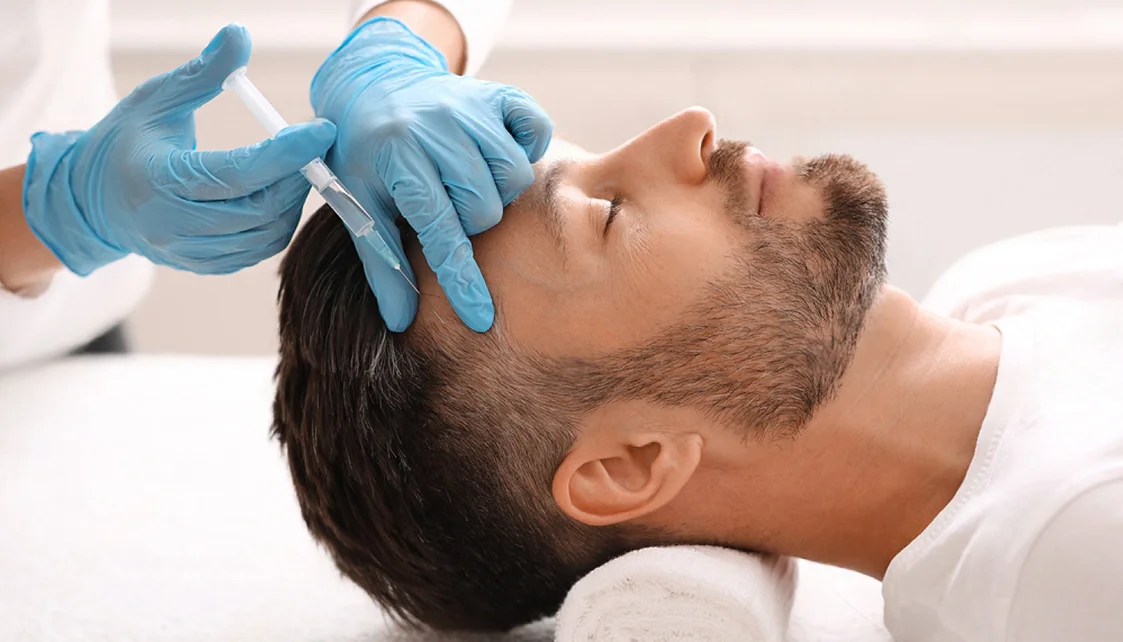
- Numbing. A local anaesthetic goes on the scalp. This is not an optional comfort measure; the injections are into a tight, well supplied area and the numbing is what makes it tolerable.
- The injections. Many small injections with a fine needle across the thinning zones, spaced in a grid so the growth factors are distributed rather than pooled.
- Out the door. You leave with a tender scalp and no dressing. Most people go straight back to work.
Allow the best part of an hour and a half for the appointment, most of which is preparation rather than needle time. Full clinical detail, including how we assess the scalp before starting, is on the PRP hair treatment page.
The timeline, month by month
| When | What is happening | What you will notice |
|---|---|---|
| Week 1 | Growth factors are active around the follicles | Scalp tenderness for a day or two. Nothing visible. |
| Weeks 2 to 6 | Follicles in the resting phase are being nudged back towards growth | Often a brief increase in shedding. This is normal and it is not the treatment failing. |
| Months 2 to 3 | New hairs entering the growth phase | Less hair in the shower drain. Usually the first real sign of change. |
| Months 3 to 6 | New growth long enough to see | Fine new hairs along the parting. Scalp less visible under bright light. |
| Month 6 onwards | Effect plateaus without maintenance | The result holds, then gradually drifts back if you stop. |
Take a photograph of your parting in the same light, at the same time of day, before your first session. Memory is a terrible instrument for measuring slow change, and almost everybody underestimates their own progress at three months because they see their scalp every morning.
Why it is not permanent, and what that costs
PRP does not cure anything. Pattern hair loss is driven by genetics and hormones, and neither of those is altered by injecting growth factors into your scalp. What PRP does is push back against the miniaturisation for as long as you keep pushing. Stop, and the underlying process carries on from where it was.
So the cost to plan for is not the initial course. It is the initial course plus a maintenance session every four to six months, indefinitely. Anyone deciding whether this is worth it should do that arithmetic before the first appointment, not after the third. It is also why PRP sits comfortably alongside minoxidil or finasteride rather than replacing them: the medications work on the hormonal driver, PRP works on the follicles, and used together they pull in the same direction.
PRP against MCT exosomes
We offer both, and patients ask which is better. They are not the same kind of thing.
| PRP | MCT exosomes | |
|---|---|---|
| Source | Your own blood, drawn on the day | A prepared product, no blood draw |
| Evidence base | 43 randomised trials pooled in 2025 | Newer, with far less randomised data behind it |
| Price at Halcyon | From £300, or £450 with Dr.OBT | From £450, or £650 with Dr.OBT |
| Best argument for it | Decades of use, your own biology, repeatable at will | No needle in your arm, and a more concentrated signal |
Our position, and you are welcome to disagree with it: start with PRP unless there is a reason not to, because the evidence behind it is far deeper and it costs less. Exosomes are the sensible next conversation for someone who has run a PRP course and wants more, or who cannot face the blood draw. There is more detail in our guide to exosome hair treatment, and if you are weighing up how long any of it lasts, is PRP hair treatment permanent goes further into the maintenance question.
Aftercare, and the shedding nobody warns you about
- No hair washing for the rest of the day. Normal shampoo from the following morning.
- No gym, sauna or steam room for 24 hours.
- No dye, bleach or chemical treatment for 48 hours.
- Paracetamol if the scalp is sore. Avoid anti inflammatories for a couple of days, since the inflammatory response is part of how the treatment works.
- Keep taking whatever you were already taking, unless we have told you otherwise.
The shed. Some people lose more hair than usual in the few weeks after starting. It is alarming, and it is the reason a fair number of people abandon a course after one session. What is happening is that follicles being pushed out of the resting phase let go of the old hair to make room for the new one. It settles. If it does not settle by about eight weeks, phone us rather than quietly giving up.
What it costs at Halcyon
Hair PRP is from £300 with our aesthetic physician and from £450 with Dr Osman Bashir Tahir. Package rates on multiple sessions are available and are worth asking about at consultation, since PRP is almost never sensible as a single appointment. MCT exosome hair therapy is from £450 and £650 respectively. Everything is published on our treatment price list.
The consultation is £200 with Dr.OBT or £100 with our aesthetic physician, redeemable against treatment. Bring any recent blood results with you if you have them, particularly ferritin and thyroid function, because they change the advice.
Frequently asked questions
Is PRP effective for hair loss?
Yes, for early to moderate pattern hair loss. A 2025 systematic review in Dermatology and Therapy pooled 43 randomised controlled trials covering 1,877 people and found activated PRP increased hair density against placebo. The same review found it did not significantly change hair thickness, and that trial protocols vary widely.
How many PRP sessions do I need for hair?
A course of sessions spaced four to six weeks apart, with the number set at your consultation according to how much thinning there is and where. After the course, maintenance every four to six months holds the result. One session on its own does not achieve anything measurable.
Will PRP regrow hair on a bald patch?
No. PRP stimulates follicles that are still alive but shrinking. Where a scalp is smooth and shiny the follicles have gone, and no injection can rebuild one. If that is your situation, a hair transplant is the conversation to have instead.
Does PRP hair treatment hurt?
The blood draw is a normal blood test. The scalp is numbed with local anaesthetic before the injections, so you feel pressure rather than the needle. Expect a tender scalp for a day or two afterwards, the way it feels after a tight ponytail.
How much does PRP hair treatment cost in London?
At Halcyon Medispa in Marylebone, hair PRP is from £300 with our aesthetic physician and from £450 with Dr Osman Bashir Tahir, with package rates available on multiple sessions. Budget for maintenance every four to six months as well as the initial course.
Why is my hair shedding more after PRP?
Follicles pushed out of the resting phase release the old hair before growing the new one, so a temporary increase in shedding in the first few weeks is expected. It usually settles within about eight weeks. If it has not, contact the clinic rather than stopping the course.
Can I have PRP alongside minoxidil or finasteride?
Yes, and combining them is common. The medications act on the hormonal driver of pattern hair loss while PRP acts on the follicles, so they work on different parts of the same problem. Tell us what you are already taking at the consultation.
Is PRP safe?
The material injected is made from your own blood, so there is no allergy or rejection risk from the plasma itself. The usual injection risks apply: tenderness, small bruises and, rarely, infection at an injection site. It is not suitable during pregnancy, with certain blood disorders, or on an infected scalp.
The first thing worth knowing is whether your follicles are still there. That is a scalp assessment, not a guess, and it is what the consultation in Marylebone is for.